Being found in an answer, not in a list.
Search engines no longer hand out a list of links; they write an answer and name a few sources. This page explains how that answer is put together and what a company can and cannot steer.
Your campaigns return less, and you are doing nothing wrong.
Same budget, same ads, same keywords, and still less comes in. That is usually not your campaign. The answer to your visitor's question now sits at the top of the search page, and that is where they stay.
With an AI answer above the results, 8 percent of visitors still click through to a website. Without it, 15 percent.
One percent clicks a source inside the answer. Pew Research Center, 68,879 searches by 900 Americans, April 2025.
Searching no longer returns a list. It returns an answer.
Someone who wants to know something types a question and gets a written answer back, with a few sources underneath. That holds for Google, and just as much for ChatGPT, Perplexity and Claude. It does not change how you are found, but what being found means.
Ten blue links
You got a list and chose yourself. At number eight you were still findable.
One answer, a few sources
The machine reads the pages, writes an answer and names a handful of sources. The rest is not shown.
You are in it or you are not there
For that one question, only whoever is named exists. There is no number eight anymore.
Four steps, and the last one decides it.
The question is taken apart
The machine works out what the question is about and which sub-questions sit underneath. One typed sentence often becomes a handful of searches.
Pages are retrieved
From the index, and with some services live from the web. A page that is not indexed or that blocks crawlers does not take part here.
The answer is written
Not copied but summarised, from several sources at once. That is why it can contain something that appeared literally nowhere.
A few sources are named
Usually three to six. That is the entire shop window. Whoever is not among them is invisible for that question, however good the page is.
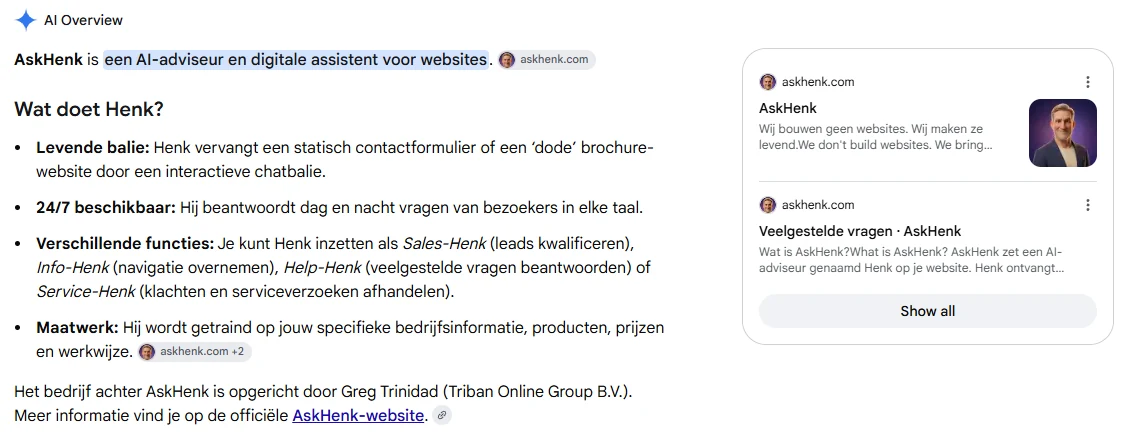
An answer engine invents nothing. It repeats what is there.
That is the most important property to understand, and at once the most useful. Whatever appears about your company in an answer comes from pages someone wrote. Usually your own, sometimes someone else's.
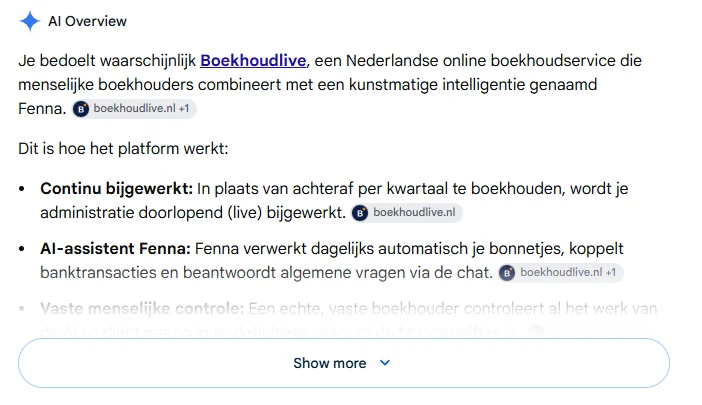
Two things follow from that
- What is not on a page cannot end up in an answer. Prices, terms, who you do and do not serve: if it is not there, the machine fills it in with what others write.
- What was there yesterday can be repeated today. Rename something and the answer lags behind for a while. That is not a fault of the machine; it reads what it has read.
Knowing your name is not the same as knowing your problem.
Someone who types your company name gets an answer about your company. That is mostly a matter of being findable and readable. But most people do not type a name. They type their problem.
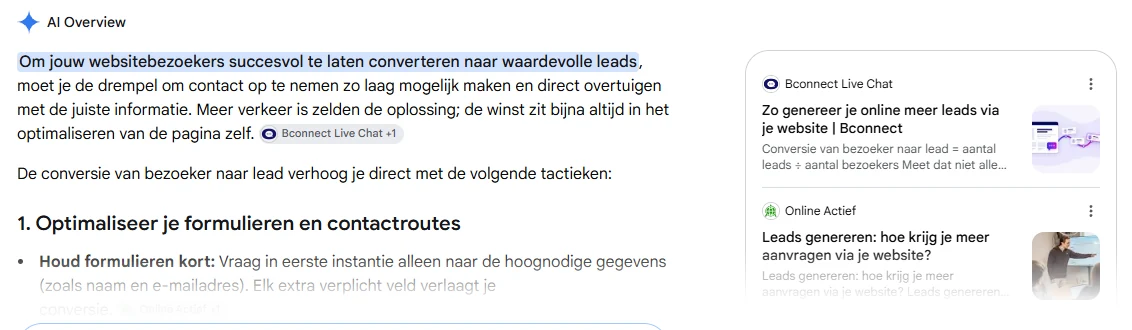
What gets cited there
Pages that answer the question. Not pages that promote a product. An answer engine looks for material to write an answer with, and a sales page is poor material for that.
Why that is awkward
The answer in this example recommends making contact forms shorter. That is the advice of ten years ago, and it is there because those are the articles written about it. Whoever publishes a better answer changes, over time, what gets repeated.
There is no separate discipline. It is simply SEO.
That is literally Google's line: optimising for AI search is optimising for search. A small industry has grown up around the terms GEO and AEO, but the advice underneath is largely the old advice.
What helps
Being indexed
A page that is not in the index or blocks crawlers cannot be cited. This is the condition all the others rest on.
Saying something not found everywhere
Google calls this non-commodity content: your own insight, your own figures, your own experience. A summary of what already exists adds nothing to a summary.
Ordinary, sound technique
Semantic HTML, a site that loads and works, no duplicate pages. The same things that always counted.
Structured data
Keep using it, but for the reason it always had: rich results. Not because a special AI variant exists.
What is not needed
An llms.txt file
Google says it does nothing for Search, AI Overviews or AI Mode. One Googler compared it to the keywords meta tag. It costs nothing, but expect nothing from it.
Chopping text up for the machine
Not needed. The systems read a page covering several topics as a whole.
Writing in a special AI style
Also not needed. Synonyms and paraphrases are understood; you do not have to hit every variant of a search term.
Arranging mentions
Bought or swapped mentions help less than it seems, and are partly recognised as spam.
This is about Google. ChatGPT, Perplexity and Claude partly fetch pages live rather than from their own index, so there it mainly counts whether your site is reachable and readable at the moment of the question.
Write the page that is the answer.
If an answer engine cites pages that answer a question, then that is the work: finding out which questions your customers ask, and answering them honestly somewhere. Not in a brochure, but in a piece of text someone can use.
- Write down the questions that keep coming up in conversations, literally as they are asked
- Answer one per page, without dancing around it
- Put in what you actually know: figures, conditions, what does not work
- Also say who it is not for; that makes the rest credible
- Keep names and terms consistent, otherwise the old version keeps circulating
- Make sure crawlers can reach it and the page is indexed
This is slow work and it pays off later. There is no button for it.
Sources
- Google Search Central — AI features and your website
- Search Engine Journal — Google's new AI search guide calls AEO and GEO 'still SEO'
- Search Engine Journal — Google's llms.txt guidance depends on which product you ask
- Pew Research Center — Google users are less likely to click on links when an AI summary appears
The screenshots on this page come from Google and were taken in November 2026. An answer engine does not give everyone the same answer and changes its answer over time; these are examples, not measurements.
Every conversation you miss costs you money.
Half an hour, no sales pitch. We look at where your leads stall and what a desk would do about it. After that you know whether it fits.